Running and Plotting Coeval Cubes
The aim of this tutorial is to introduce you to how 21cmFAST does the most basic operations: producing single coeval cubes, and visually verifying them. It is a great place to get started with 21cmFAST.
[8]:
# We change the default level of the logger so that
# we can see what's happening with caching.
import logging

import matplotlib.pyplot as plt

logger = logging.getLogger("py21cmfast")
logger.setLevel(logging.INFO)

from tempfile import mkdtemp

import py21cmfast as p21c

# For plotting the cubes, we use the plotting submodule:
from py21cmfast import plotting
[9]:
print(f' Using 21cmFAST version {p21c.__version__}')
Using 21cmFAST version 4.0.0b1.dev312+gb6f5204f.d20250728
Run a simulation using run_coeval and generate_coeval
Specifying input parameters is a topic covered in a different tutorial. Here, we want something small and fast:
[10]:
inputs = p21c.InputParameters.from_template(
    ["simple", 'small'], random_seed=1234
)
The simplest (and typically most efficient) way to produce a coeval cube is simply to use the run_coeval method. This consistently performs all steps of the calculation, re-using any data that it can without re-computation or increased memory overhead.
First we make a temporary cache to store our fields, in larger runs 21cmFAST can store its outputs in an OutputCache to avoid unnecessary regeneration
[11]:
cache = p21c.OutputCache(mkdtemp())
[12]:
coevals = p21c.run_coeval(
    inputs=inputs,
    out_redshifts=[8, 9, 10],
    cache=cache,
    progressbar=True
)
The generate_coeval method is a generator, which can be called as follows:
[13]:
coevals = []
for coeval,in_outputs in p21c.generate_coeval(
    inputs=inputs,
    out_redshifts=[8, 9, 10],
    cache=cache,
):
    if in_outputs:
        coevals.append(coeval)
Note that this run was much faster, since we cached the outputs from the previous run, and they were simply loaded instead of re-calculated
There are a number of possible inputs for generate/run_coeval, which you can check out either in the API reference or by calling help(p21c.run_coeval).
Notably, in our case here, the out_redshifts must be given: these are the redshifts at which we compute the coeval boxes. When the simulation requires evolution over cosmic history, coeval boxes will be computed at every node as well as any out_redshifts specified.
Since the function is a generator, it yields a Coeval box on each iteration. These boxes can be saved or post-processed before completing the next iteration, allowing arbitrarily flexible computations to be performed. The second returned values is a boolean which tells you whether you are at a requested output point in out_redshifts.
We’ve also given a cache parameter: this specifies a directory in which the various component calculations of this simulation will be cached. By default, this will occur in the current directory, but here we are using a temporary directory for convenience. While by default all sub-components are written into the cache, this can be turned off altogether, or toggled per subcomponent. The main reason to use the cache is if you might want to re-use simulated component boxes in other simulations
in the future. A prime example of this is the InitialConditions, for which a single simulation can be used for a multitude of astrophysical simulations with varying AstroParams.
The output on each iteration is, as we have mentioned, a Coeval object. This is a simple object that contains a number of 3D arrays of data, one for each of the component fields simulated. They can be accessed as attributes of the object:
[14]:
coevals[0].redshift
[14]:
10.0
A list of all simulated fields can be accessed:
[15]:
coevals[0].get_fields()
[15]:
['lowres_density',
 'lowres_vx',
 'lowres_vy',
 'lowres_vz',
 'hires_density',
 'hires_vx',
 'hires_vy',
 'hires_vz',
 'lowres_vx_2LPT',
 'lowres_vy_2LPT',
 'lowres_vz_2LPT',
 'hires_vx_2LPT',
 'hires_vy_2LPT',
 'hires_vz_2LPT',
 'lowres_vcb',
 'density',
 'velocity_z',
 'velocity_x',
 'velocity_y',
 'neutral_fraction',
 'ionisation_rate_G12',
 'mean_free_path',
 'z_reion',
 'cumulative_recombinations',
 'kinetic_temperature',
 'unnormalised_nion',
 'unnormalised_nion_mini',
 'brightness_temp',
 'tau_21',
 'spin_temperature',
 'xray_ionised_fraction',
 'kinetic_temp_neutral',
 'J_21_LW',
 'halo_mass',
 'halo_stars',
 'halo_stars_mini',
 'count',
 'halo_sfr',
 'halo_sfr_mini',
 'halo_xray',
 'n_ion',
 'whalo_sfr']
The Coeval object also maintains a reference to the input parameters:
[16]:
coevals[0].inputs
[16]:
cosmo_params: CosmoParams(SIGMA_8=0.8102, hlittle=0.6766, OMm=0.30964144154550644, OMb=0.04897468161869667, POWER_INDEX=0.9665, OMn=0.0, OMk=0.0, OMr=8.6e-05, OMtot=1.0, Y_He=0.24, wl=-1.0)
simulation_options: SimulationOptions(HII_DIM=64, _BOX_LEN=None, _DIM=None, _HIRES_TO_LOWRES_FACTOR=None, _LOWRES_CELL_SIZE_MPC=None, NON_CUBIC_FACTOR=1.0, N_THREADS=1, SAMPLER_MIN_MASS=100000000.0, SAMPLER_BUFFER_FACTOR=2.0, N_COND_INTERP=200, N_PROB_INTERP=400, MIN_LOGPROB=-12.0, HALOMASS_CORRECTION=0.89, PARKINSON_G0=1.0, PARKINSON_y1=0.0, PARKINSON_y2=0.0, Z_HEAT_MAX=35.0, ZPRIME_STEP_FACTOR=1.1, INITIAL_REDSHIFT=300.0, DELTA_R_FACTOR=1.1, DENSITY_SMOOTH_RADIUS=0.2, DEXM_OPTIMIZE_MINMASS=100000000000.0, DEXM_R_OVERLAP=2.0, CORR_STAR=0.5, CORR_SFR=0.2, CORR_LX=0.2)
matter_options: MatterOptions(HMF='ST', USE_RELATIVE_VELOCITIES=False, POWER_SPECTRUM='EH', PERTURB_ON_HIGH_RES=False, USE_INTERPOLATION_TABLES='hmf-interpolation', MINIMIZE_MEMORY=False, KEEP_3D_VELOCITIES=False, SAMPLE_METHOD='MASS-LIMITED', FILTER='spherical-tophat', HALO_FILTER='spherical-tophat', SMOOTH_EVOLVED_DENSITY_FIELD=False, DEXM_OPTIMIZE=False, PERTURB_ALGORITHM='2LPT', USE_FFTW_WISDOM=False, USE_HALO_FIELD=False, FIXED_HALO_GRIDS=False, HALO_STOCHASTICITY=False)
astro_params: AstroParams(HII_EFF_FACTOR=30.0, F_STAR10=-1.3, ALPHA_STAR=0.5, F_STAR7_MINI=-2.8, ALPHA_STAR_MINI=0.5, F_ESC10=-1.0, ALPHA_ESC=-0.5, F_ESC7_MINI=-2.0, M_TURN=8.7, R_BUBBLE_MAX=32.0, R_BUBBLE_MIN=0.620350491, ION_Tvir_MIN=4.69897, L_X=40.5, L_X_MINI=40.5, NU_X_THRESH=500.0, X_RAY_SPEC_INDEX=1.0, X_RAY_Tvir_MIN=4.69897, F_H2_SHIELD=0.0, t_STAR=0.5, A_LW=2.0, BETA_LW=0.6, A_VCB=1.0, BETA_VCB=1.8, UPPER_STELLAR_TURNOVER_MASS=11.447, UPPER_STELLAR_TURNOVER_INDEX=-0.6, SIGMA_STAR=0.25, SIGMA_LX=0.5, SIGMA_SFR_LIM=0.19, SIGMA_SFR_INDEX=-0.12, T_RE=20000.0, FIXED_VAVG=25.86, POP2_ION=5000.0, POP3_ION=44021.0, PHOTONCONS_CALIBRATION_END=3.5, CLUMPING_FACTOR=2.0, ALPHA_UVB=5.0, R_MAX_TS=500.0, N_STEP_TS=40, MAX_DVDR=0.2, DELTA_R_HII_FACTOR=1.1, NU_X_BAND_MAX=2000.0, NU_X_MAX=10000.0)
astro_options: AstroOptions(USE_MINI_HALOS=False, USE_CMB_HEATING=True, USE_LYA_HEATING=True, USE_MASS_DEPENDENT_ZETA=True, INHOMO_RECO=False, USE_TS_FLUCT=False, FIX_VCB_AVG=False, USE_EXP_FILTER=False, CELL_RECOMB=False, PHOTON_CONS_TYPE='no-photoncons', USE_UPPER_STELLAR_TURNOVER=False, M_MIN_in_Mass=True, HALO_SCALING_RELATIONS_MEDIAN=False, HII_FILTER='sharp-k', HEAT_FILTER='spherical-tophat', IONISE_ENTIRE_SPHERE=False, AVG_BELOW_SAMPLER=True, INTEGRATION_METHOD_ATOMIC='GAUSS-LEGENDRE', INTEGRATION_METHOD_MINI='GAUSS-LEGENDRE')
We can also save/load a Coeval object to disk:
[17]:
coevals[0].save(cache.direc / "coeval.h5")
Note that, if you are also using the cache (as we are), then saving the Coeval object creates redundant data on disk. The files created by Coeval are more convenient for saving, sharing and using in further post-processing, but are not easily used for caching purposes.
The file that we wrote can be easily read:
[18]:
coeval10 = p21c.Coeval.from_file(cache.direc / "coeval.h5")
Some convenient plotting functions exist in the plotting module. These can work directly on Coeval objects, or any of the output structs (as we’ll see further on in the tutorial). By default the coeval_sliceplot function will plot the brightness_temp, using the standard traditional colormap:
[19]:
fig, ax = plt.subplots(1, 3, figsize=(14, 4))
for i, coeval in enumerate(coevals):
    plotting.coeval_sliceplot(coeval, ax=ax[i], fig=fig)
    plt.title(f"z = {coeval.redshift}")
plt.tight_layout()
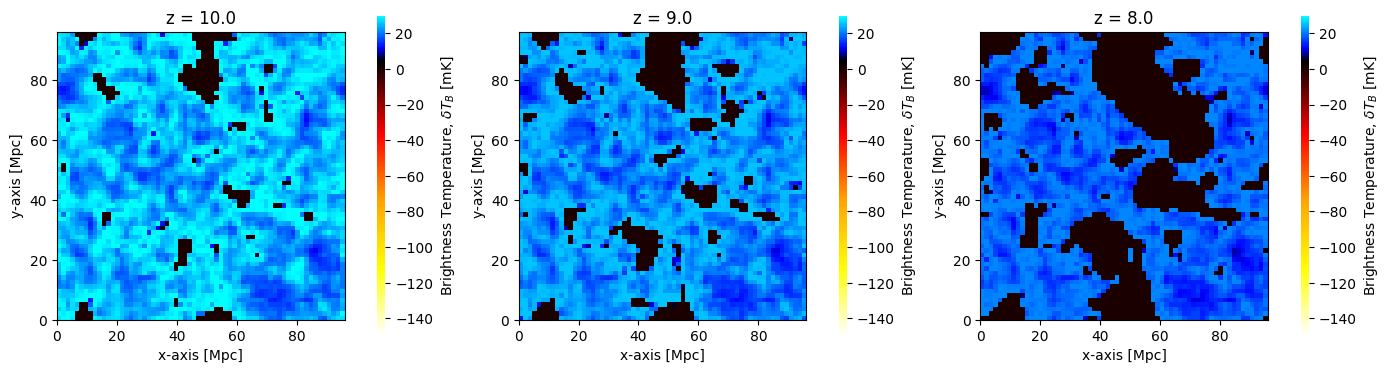
Any 3D field can be plotted, by setting the kind argument. For example, we could alternatively have plotted the dark matter density cubes perturbed to each redshift:
[20]:
fig, ax = plt.subplots(1, 3, figsize=(14, 4))
for i, coeval in enumerate(coevals):
    plotting.coeval_sliceplot(coeval, kind="density", ax=ax[i], fig=fig)
    plt.title(f"z = {coeval.redshift}")
plt.tight_layout()
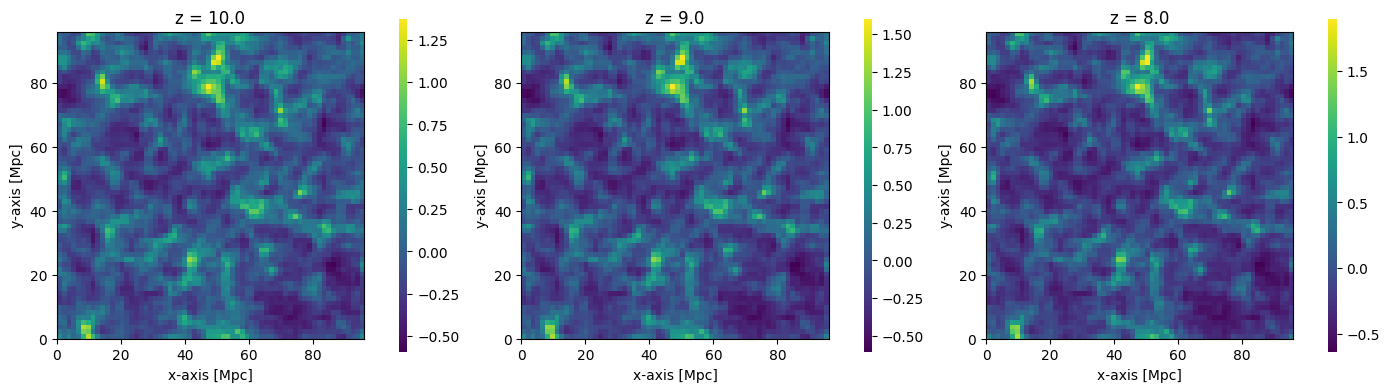
To see more options for the plotting routines, see the API Documentation.
This brief example covers most of the basic usage of 21cmFAST (at least with Coeval objects – there are also Lightcone objects for which there is a separate tutorial).
For the rest of the tutorial, we’ll cover a more advanced usage, in which each step of the calculation is done independently.
Advanced Step-by-Step Usage
Most users most of the time will want to use the high-level run_coeval function from the previous section. However, there are several independent steps when computing the brightness temperature field, and these can be performed one-by-one, adding any other effects between them if desired. In this section, we’ll go through in more detail how to use the lower-level methods.
Each step is performed by running a function which will return a single object. Every major function returns an object of the same fundamental class (an OutputStruct) which has methods to share its underlying data with the backend C code, and maintain knowledge of the state of its memory.
As we move through each step, we’ll outline some extra details, hints and tips about using these inputs and outputs.
The first thing to do is to set up the input parameters. Here, we’ll use the same basic set of parameters as we used in run_coeval, but with a different random seed, which ensures that we compute all new boxes.
[21]:
new_inputs = inputs.clone(random_seed=42)
Initial Conditions
The first step is to get the initial conditions, which defines the cosmological density field before any redshift evolution is applied.
[22]:
initial_conditions = p21c.compute_initial_conditions(
    inputs=new_inputs, cache=cache, write=True
)
As we said, all of these “single field” functions return objects of type OutputStruct. These objects have a few things in common. For example, they hold a reference to their input parameters:
[23]:
initial_conditions.inputs.simulation_options.HII_DIM
[23]:
64
More importantly, once computed, they hold the simulated data. This data is held in special Array objects, and all the available simulated fields can be accessed through the .arrays attribute:
[24]:
initial_conditions.arrays.keys()
[24]:
dict_keys(['lowres_density', 'lowres_vx', 'lowres_vy', 'lowres_vz', 'hires_density', 'lowres_vx_2LPT', 'lowres_vy_2LPT', 'lowres_vz_2LPT', 'hires_vx_2LPT', 'hires_vy_2LPT', 'hires_vz_2LPT'])
As we mentioned, the values of these attributes are not numpy arrays, but custom Array objects. These have the ability to track their state: whether they initialized, computed, stored on disk, etc., and they also know how to share themselves with the C backend. While this is useful for the simulation, it is not that helpful to you as a user. That’s OK: these objects aren’t really meant to be the primary way you interact with 21cmFAST as a user.
However, to get at the underlying numpy array, you can use the .get() method:
[25]:
initial_conditions.get("lowres_density").mean()
[25]:
np.float32(0.00012248568)
This has the handy feature that even if the array has been purged from memory but stored on disk, the .get() method will still return the array (it will read it from disk, and store it back on the object until you tell the object to purge it again).
For example:
[26]:
initial_conditions.purge()
Once purged, the array’s state shows that it is not initialized or in memory, but it is stored on disk (because we passed write=True when computing it):
[27]:
initial_conditions.lowres_density.state
[27]:
ArrayState(initialized=False, c_memory=False, computed_in_mem=False, on_disk=True)
However, when we use .get(), the array is re-loaded:
[28]:
initial_conditions.get("lowres_density").mean()
[28]:
np.float32(0.00012248568)
[29]:
initial_conditions.lowres_density.state
[29]:
ArrayState(initialized=True, c_memory=False, computed_in_mem=True, on_disk=True)
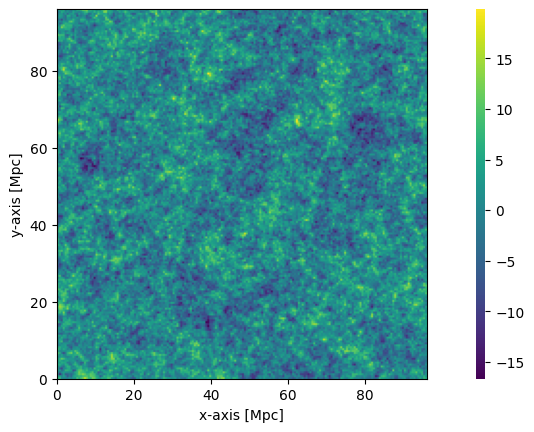
The coeval_sliceplot function also works on OutputStruct objects (as well as the Coeval object as we’ve already seen). It takes the object, and a specific field name. By default, the field it plots is the first field in arrays (for any OutputStruct).
[30]:
plotting.coeval_sliceplot(initial_conditions, "hires_density");
Perturbed Field
After obtaining the initial conditions, we need to perturb the field to a given redshift (i.e. the redshift we care about). This step clearly requires the results of the previous step, which we can easily just pass in. Let’s do that:
[31]:
perturbed_field = p21c.perturb_field(
    redshift=8.0, initial_conditions=initial_conditions
)
Note that we didn’t need to pass in any input parameters, because they are all contained in the initial_conditions object itself. The random seed is also taken from this object.
Again, the output is an OutputStruct, so we can view its fields:
[32]:
perturbed_field.arrays.keys()
[32]:
dict_keys(['density', 'velocity_z'])
This time, it has only density and velocity (the velocity direction is chosen without loss of generality). Let’s view the perturbed density field:
[33]:
plotting.coeval_sliceplot(perturbed_field, "density");
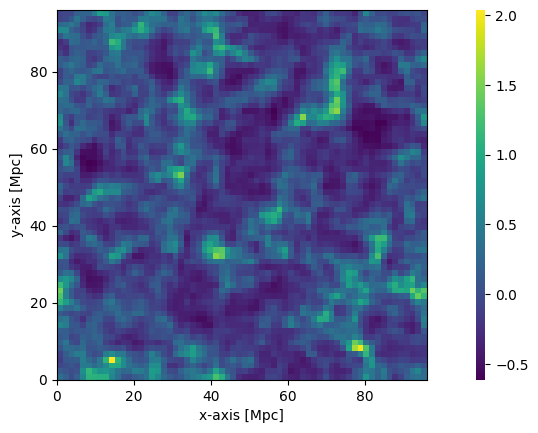
It is clear here that the density used is the low-res density, but the overall structure of the field looks very similar.
Ionization Field
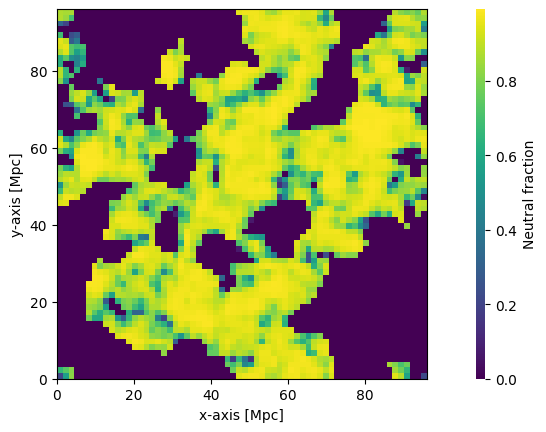
Next, we need to ionize the box. This is where things get a little more tricky. In the simplest case we are using in this tutorial, the ionization occurs at the saturated limit, which means we can safely ignore the contribution of the spin temperature fluctuations. This means we can directly calculate the ionization on the density/velocity fields that we already have.
[34]:
ionized_field = p21c.compute_ionization_field(
    initial_conditions=initial_conditions, perturbed_field=perturbed_field
)
Let’s see the fieldnames:
[35]:
ionized_field.arrays.keys()
[35]:
dict_keys(['neutral_fraction', 'ionisation_rate_G12', 'mean_free_path', 'z_reion', 'kinetic_temperature', 'unnormalised_nion'])
Let’s plot the neutral fraction:
[36]:
plotting.coeval_sliceplot(ionized_field, "neutral_fraction");
Brightness Temperature
Now we can use what we have to get the brightness temperature:
[37]:
brightness_temp = p21c.brightness_temperature(
    ionized_box=ionized_field, perturbed_field=perturbed_field
)
This has only a single field, brightness_temp:
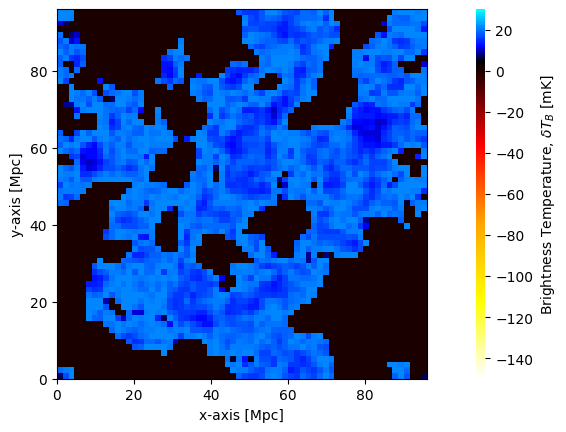
[38]:
plotting.coeval_sliceplot(brightness_temp);